en
en  English
 中文简体
中文简体
 русский
 عربى
عربى
Content
- 1 The Growing Demand for Freight Elevators in Industrial Logistics
- 2 What Is a Freight Elevator and How Does It Work?
- 3 Key Specifications: What to Look for When Choosing a Freight Elevator
- 4 Industry Applications: Where Freight Elevators Make the Biggest Difference
- 5 Smart and Energy-Efficient Freight Elevators: The Modern Standard
- 6 Compliance and Safety: What Every Facility Manager Should Know
The Growing Demand for Freight Elevators in Industrial Logistics
As global e-commerce volumes continue to break records and manufacturing facilities expand vertically to maximize land use, the demand for reliable vertical cargo transportation has never been stronger. Freight elevators have emerged as a critical infrastructure component in warehouses, distribution centers, factories, and multi-story commercial buildings — enabling facilities to move goods efficiently between floors without disrupting operations or risking worker safety.
According to industry forecasts, the global cargo elevator market is expected to grow steadily through the latter half of this decade, driven by the rise of just-in-time inventory models, urban warehouse development, and stricter workplace safety regulations. For facility managers and procurement teams evaluating vertical transport solutions, understanding what sets a purpose-built freight elevator apart — and how to select the right one — is more important than ever. Explore our full range of freight elevator products designed for industrial and commercial applications.
What Is a Freight Elevator and How Does It Work?
A freight elevator — also known as a cargo elevator or goods lift — is a specialized vertical transportation system engineered to carry heavy goods, materials, and industrial equipment between building floors. Unlike passenger elevators that prioritize comfort, aesthetics, and speed, freight elevators are designed around three core priorities: load capacity, structural durability, and safe loading access.
At the mechanical level, freight elevators operate on either a traction or hydraulic drive system. Traction-based systems use steel wire ropes or coated steel belts driven by a gearless motor, making them well-suited for taller buildings and high-frequency use. Hydraulic systems rely on a pressurized fluid piston mechanism, offering cost advantages for low-rise, lower-frequency applications. Both systems are equipped with multiple redundant safety devices — including overspeed governors, safety brakes, and buffer systems — to protect both cargo and operators.
The interior construction of a freight elevator is fundamentally different from a passenger cabin. Platforms are reinforced with heavy-gauge steel plate supported by structural I-beams, walls are lined with impact-resistant panels, and door systems are designed to accommodate wide, oversized loads. For a deeper technical breakdown, see our complete guide to cargo lifts.
Key Specifications: What to Look for When Choosing a Freight Elevator
Selecting the right freight elevator requires matching equipment specifications to your facility's actual operational demands. The following factors are the most consequential in the decision-making process:
- Load Capacity: Freight elevators typically range from 1,000 kg to 10,000 kg. Industry best practice is to specify a unit rated for at least 125% of your maximum anticipated load to account for dynamic forces during acceleration and braking.
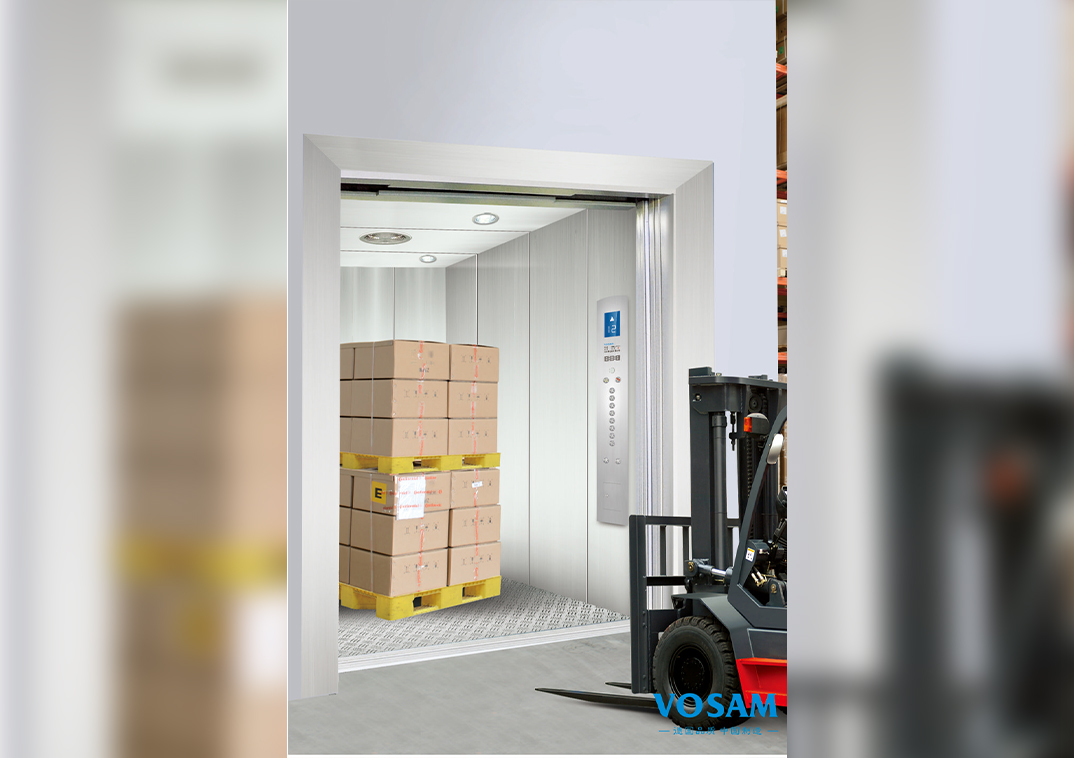
- Platform Dimensions: Standard platforms range from roughly 1.5m × 2m to 3m × 4m. If forklifts or pallet jacks must enter the cabin, the platform width must accommodate turning radius and load width simultaneously.
- Door Configuration: Vertical bi-parting doors are the most common in industrial settings as they maximize clear opening height without consuming floor space. Side-sliding and through-doors are alternatives for specific layout requirements. Vosam freight elevators support four door opening methods — side-opening bi-folding, center-opening bi-folding, single-pass, and through-doors — to suit diverse facility layouts.
- Travel Speed: Freight elevators typically operate at 0.25 m/s to 1.0 m/s. For high-throughput operations, a faster unit reduces waiting time and improves overall logistics efficiency.
- Drive System: Hydraulic drives suit low-rise, lower-frequency operations with a lower upfront cost. Traction drives with variable-frequency control are preferable for taller buildings and more frequent use cycles, offering significantly better long-term energy efficiency.
| Application | Recommended Capacity | Drive Type | Door Type |
|---|---|---|---|
| Warehouse / Distribution | 3,000 – 10,000 kg | Traction (VFD) | Vertical bi-parting |
| Manufacturing Plant | 2,000 – 5,000 kg | Traction or Hydraulic | Through-door or side-sliding |
| Retail / Commercial | 1,000 – 3,000 kg | Hydraulic or Traction | Center-opening bi-folding |
| Hospital / Healthcare | 1,500 – 3,000 kg | Traction (low-noise) | Wide single-pass |
Industry Applications: Where Freight Elevators Make the Biggest Difference
Freight elevators are deployed across a wide range of industries, each with distinct operational requirements:
- Warehousing and E-Commerce Fulfillment: Multi-story warehouses require high-capacity elevators capable of accommodating forklifts and fully loaded pallets. Fast cycle times and durable construction are essential to keep pick-and-pack operations on schedule.
- Manufacturing and Heavy Industry: Factories transporting raw materials, semi-finished goods, or heavy machinery between production floors benefit from Class C freight elevators engineered for concentrated point loads and continuous daily use.
- Retail and Department Stores: Multi-floor retail environments rely on freight elevators to replenish merchandise from stockrooms and loading docks to the sales floor efficiently — without interfering with the customer experience.
- Hospitals and Healthcare Facilities: While bed elevators handle patient transport, freight elevators in hospitals move laundry, medical supplies, catering equipment, and waste — environments requiring quiet, smooth operation and strict hygiene standards. For lighter loads in food service and hospitality contexts, a dumbwaiter elevator may be a more cost-effective alternative.
Smart and Energy-Efficient Freight Elevators: The Modern Standard
The freight elevator market has undergone significant technological advancement over the past decade. Variable-frequency drive (VFD) systems are now the industry standard for new installations, enabling smooth acceleration and deceleration that reduces mechanical wear, lowers energy consumption, and minimizes load shift during travel. Compared to older fixed-speed drive systems, VFD-equipped elevators can reduce energy use by up to 40% over a full operational lifecycle.
Gearless permanent magnet synchronous traction machines have replaced geared motors in many high-duty-cycle applications. These systems deliver quieter operation, higher leveling accuracy — often within ±1 mm — and require less routine maintenance due to the elimination of gearbox lubrication requirements. For facilities handling fragile or sensitive cargo, this precision in floor leveling prevents load damage during unloading.
Intelligent control systems now allow freight elevators to integrate with warehouse management software, enabling automated dispatch, usage analytics, and predictive maintenance alerts. Remote monitoring capabilities help facility managers identify abnormal operating patterns before they develop into costly downtime events.
Compliance and Safety: What Every Facility Manager Should Know
Freight elevator installations are subject to rigorous regulatory oversight. In North America, the governing standard is ASME A17.1, which classifies freight elevators into five categories (Class A through E) based on loading method and maximum cargo increments. Class C — general freight loading via powered industrial trucks — is the most common classification in warehouse and manufacturing environments.
The 2025 update to ASME A17.1 introduced several important provisions that directly affect freight elevator installations, including expanded fire alarm integration requirements, mandatory Phase I emergency recall for elevators rising 25 feet or more above the main floor, and stricter door contact monitoring protocols in major jurisdictions. In Europe, compliance is governed by EN 81-20 and EN 81-50, while China's GB 7588 standard applies to domestic installations — all of which Vosam's engineering team is well-versed in for export and multinational projects.
Beyond code compliance, routine inspection and maintenance are non-negotiable. Most jurisdictions require annual inspections by a licensed elevator inspector, with a valid certificate posted in or near the car. Facilities that neglect inspection schedules face potential fines, forced shutdowns, and liability exposure in the event of an incident. For a detailed breakdown of the latest regulatory changes, refer to our article on new elevator code requirements and their implications for freight elevator operators.
Investing in a well-specified, properly maintained freight elevator is ultimately an investment in operational continuity, workforce safety, and long-term cost efficiency. As industrial facilities grow in complexity and throughput demands, the freight elevator remains one of the most indispensable — and often underestimated — components of a productive vertical supply chain.