en
en  English
 中文简体
中文简体
 русский
 عربى
عربى
Parking Demand Is Outpacing Available Land
Urban land costs have climbed steadily for decades, but the pressure on parking infrastructure has reached a tipping point. According to market research published in 2026, the global parking lots and garages market is projected to grow from $93.99 billion in 2025 to $112.5 billion by 2030—driven by rapid urbanization, rising vehicle ownership, and the expansion of commercial and transit infrastructure. review the full parking market growth forecast.
The challenge is simple: more cars, less ground to put them on. In dense city centers, developers can no longer afford to dedicate large floor plates to ramps and drive aisles. A conventional parking garage consumes roughly 150 to 180 square feet per vehicle once circulation space is factored in. That is prime real estate doing nothing but holding cars. Parking garage elevators offer a fundamentally different answer—move vehicles vertically, not horizontally, and recover that space for higher-value uses.
Content
How Parking Garage Elevators Work
A parking garage elevator transports vehicles between levels using a motorized lift platform rather than a driven ramp. The driver maneuvers onto the platform at grade, exits the vehicle, and the system raises or lowers the car to the designated storage level. Retrieval works in reverse. The entire sequence typically takes under two minutes and requires no driver involvement beyond initial positioning.
The core mechanism varies by system type, but most rely on hydraulic cylinders or chain-driven hoists to generate vertical movement. Unlike conventional passenger elevator systems designed for human transport, parking garage elevators are engineered around much heavier dynamic loads, wider cabin dimensions, and load distribution patterns suited to vehicle axles rather than standing occupants. That distinction shapes every engineering decision, from pit depth to platform surface design.
The result is a system that eliminates ramps entirely. No ramp means no wasted floor area on curved or inclined transitions, no minimum ceiling clearance for driver headroom in transit, and no structural grade beam complications that ramp geometry typically demands.
Types of Parking Garage Elevator Systems
Not every project has the same footprint, load requirement, or budget. Four primary system types address that range:
- Scissor-type (hydraulic platform lifts) — The most versatile option for underground and basement-level parking. The platform sits at grade when idle and descends into a pre-excavated pit. Lifting capacities commonly range from 3,000 kg to 20,000 kg, making them compatible with SUVs, pickup trucks, and light commercial vehicles as well as standard sedans.
- Four-post lifts — Four vertical columns support a single platform, creating a stable, low-maintenance structure suited to residential garages and villa projects. Easier to relocate than pit-based systems and typically cost-efficient for capacities up to 5,000 kg.
- Two-post lifts — A compact footprint option for tight sites. Capacity is lower (generally under 3,500 kg), but the reduced structural requirement makes installation faster and less invasive for existing buildings.
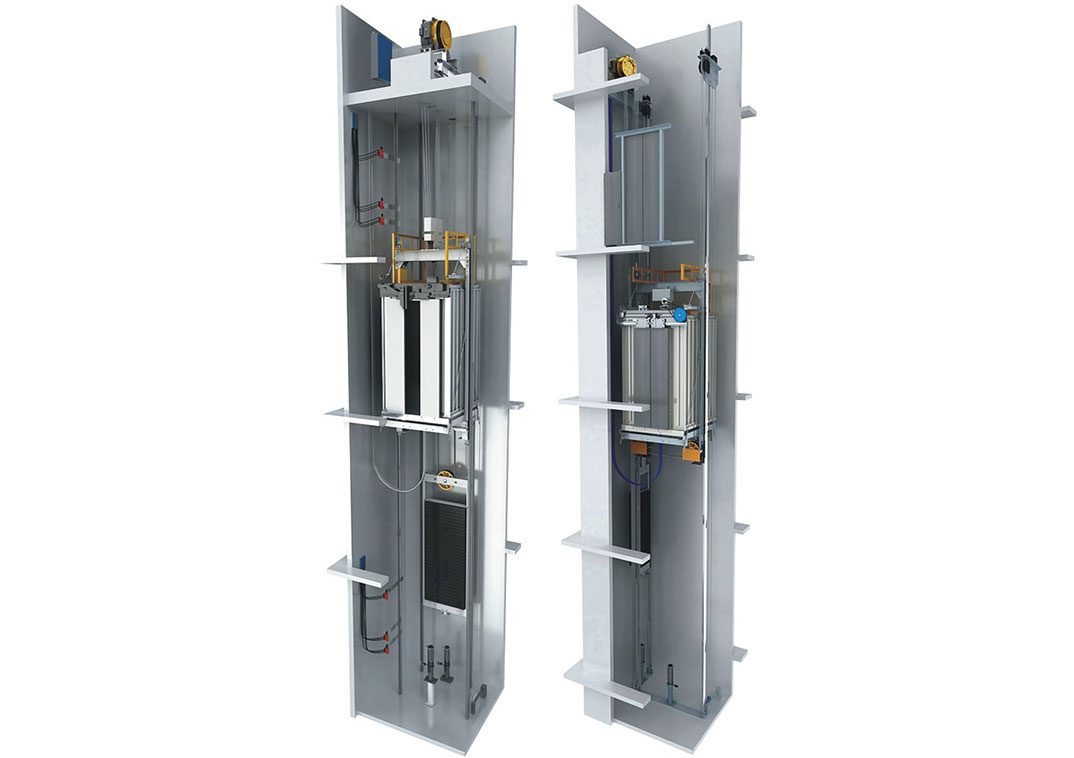
- Shaft-type enclosed systems — High-rise applications and automated parking towers use enclosed vertical shafts, similar in concept to a freight elevator but purpose-built for vehicles. These integrate directly with automated guided vehicle (AGV) systems in fully robotic parking garages.
Drive system technology also separates systems meaningfully. Variable voltage variable frequency (VVVF) control has become increasingly common in modern installations because it smooths acceleration and deceleration, reducing mechanical stress and improving ride consistency. how VVVF technology benefits car elevator performance is a relevant consideration when evaluating long-term operating costs and platform longevity. For projects requiring transport of unusually heavy or bulky loads, freight elevator systems for heavy-load applications may offer a better-aligned specification.
Safety Standards Built Into Every System
Parking garage elevators carry loads that dwarf standard elevator cabins, which makes redundant safety engineering non-negotiable. Modern systems layer multiple independent protection mechanisms:
- Anti-fall mechanical locks — Engage automatically if hydraulic pressure drops unexpectedly, physically preventing platform descent outside of commanded operation.
- Explosion-proof hydraulic valves — Isolate the hydraulic circuit in the event of hose failure, holding the platform in position rather than allowing uncontrolled lowering.
- Overload protection sensors — Prevent operation if vehicle weight exceeds the rated capacity, protecting both the structure and the vehicle being transported.
- Photocell and limit switch arrays — Detect obstructions in the lift path and enforce precise stopping positions at each level, eliminating misalignment between platform and floor surface.
- Emergency stop systems — Halt all movement immediately on operator command or automatic fault detection, with manual release procedures for service access.
Well-specified systems meet both local building codes and internationally recognized standards. Buyers sourcing equipment internationally should confirm which testing and certification framework the product was validated against before specifying it for permitted construction.
Where Parking Garage Elevators Are Being Deployed
The applications extend well beyond boutique residential projects. Across building typologies, parking garage elevators are addressing real operational problems:
- Mixed-use residential towers — Underground podium parking accessed by lift rather than ramp reclaims the basement perimeter for storage, bike facilities, or building services. In cities where floor area ratios are tightly controlled, that reclaimed area has measurable value.
- Luxury villas and private residences — Concealed below-grade parking preserves landscaping and eliminates visible garage doors from the street facade. Multiple vehicles can be stacked on scissor-type platforms without increasing the surface footprint.
- Car dealerships and showrooms — Display inventory across multiple levels without requiring customers or staff to drive through internal ramps. car elevator solutions for commercial and residential projects now serve dealerships ranging from compact urban showrooms to multi-brand campuses.
- Transit-adjacent developments — Station-area projects in Tokyo, Seoul, and major European cities have integrated elevator-accessed parking to meet density targets while satisfying local parking requirements.
- Multi-use developments combining retail, office, and hospitality — passenger elevator options for multi-use developments often share a core with dedicated vehicle lift shafts in larger projects, simplifying the vertical circulation plan.
What Developers and Architects Should Evaluate
Selecting the right parking garage elevator is less about picking a product from a catalog and more about matching system specifications to site constraints from the earliest design stage. Several factors consistently drive the decision:
Structural load capacity is the first filter. The slab, beams, and footings beneath the lift must accommodate not just the vehicle weight but the dynamic loads generated during lifting and lowering. structural load considerations for car elevator installations should be confirmed with the structural engineer of record before specifying pit dimensions or anchor bolt layouts.
Pit depth directly affects excavation cost and schedule. Hydraulic scissor systems often require as little as 500 mm of pit depth at minimum, a significant advantage over traditional underground parking construction. Shaft-type systems require deeper excavation but serve high-rise applications that simpler lifts cannot.
Vehicle mix determines the required platform width and lifting capacity. A residential installation serving standard sedans has very different requirements from a commercial facility handling SUVs, pickup trucks, or delivery vans. Specifying to the 95th-percentile vehicle in the expected fleet avoids operational restrictions after handover.
Maintenance access and lifecycle cost are often underweighted at the specification stage. Hydraulic systems use components that are widely available and serviceable by general mechanical contractors in most markets, which keeps long-term maintenance costs predictable. Enclosed shaft-type systems in automated garages require more specialized servicing but offer higher throughput for large-scale facilities.
As land values continue to rise and urban density targets tighten, parking garage elevators are moving from a premium option to a practical baseline for serious development projects. The projects delivering the best outcomes are those that treat the vehicle lift as a core structural element from day one—not a retrofit solved in the final design stages.