en
en  English
 中文简体
中文简体
 русский
 عربى
عربى
Content
What Sets a Warehouse Elevator Apart
A standard passenger elevator is built around comfort — smooth ride, polished interiors, strict weight limits for human occupants. A warehouse elevator is built around something entirely different: the relentless movement of goods, shift after shift, floor after floor. The structural demands, load profiles, and regulatory classifications are fundamentally distinct.
Under the ASME A17.1 Safety Code for Elevators and Escalators — the primary standard referenced by regulators across North America — freight elevators are defined as those used primarily for carrying freight, with only the operator and loading personnel permitted to ride. That distinction matters: it unlocks heavier rated capacities, industrial-grade cab finishes, and purpose-built door systems that would be impractical in passenger applications.
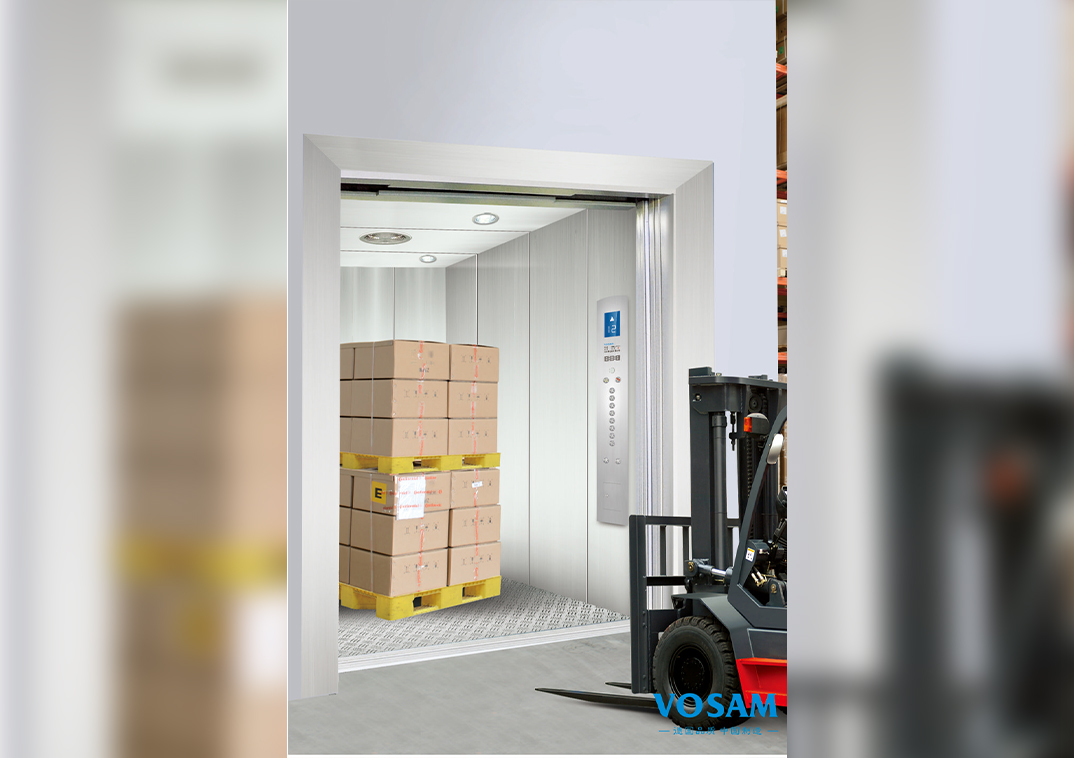
In practice, a warehouse elevator is expected to handle palletized loads, forklifts, heavy machinery, and bulk materials — sometimes dozens of cycles per day. The cab walls are reinforced, the threshold plates are flush for easy pallet entry, and the control systems are optimized for cycle time rather than comfort. If your facility moves products between floors, investing in industrial-grade freight elevators built for heavy-load transport is the foundation of a safe, efficient operation.
Types of Warehouse Elevators
No single design suits every warehouse. The right choice depends on floor count, load weight, cycle frequency, and available footprint. Here are the four main categories you'll encounter:
Hydraulic Freight Elevators
These use a fluid-driven piston to raise and lower the cab. Hydraulic systems are well-suited to low- and mid-rise applications — typically two to four floors — and are known for smooth, quiet operation. They require a pump unit and fluid reservoir, which means a dedicated machine room, but they handle heavy loads reliably with relatively straightforward maintenance. The trade-off is energy consumption: the pump runs continuously during ascent, making hydraulic units less efficient than traction counterparts over high daily cycles.
Traction Freight Elevators
Steel cables or belts run over a sheave, with a counterweight offsetting much of the cab's mass. Traction systems are significantly more energy-efficient at higher floors and faster speeds — well-suited to three-story-plus facilities with heavy daily usage. They do require overhead clearance for the machine room (or a machine-room-less design that integrates components into the shaft), and upfront installation cost is higher. For distribution centers moving dozens of pallet loads per hour, the operating cost savings over a decade typically justify the premium.
Chain-Driven Freight Elevators
Heavy-duty chains lift the platform along rigid guide rails, making this design a popular mid-capacity option (typically 2,000–7,000 kg) where simplicity and minimal pit depth are priorities. There is no hydraulic fluid to manage or leak, which keeps the installation cleaner and reduces certain maintenance concerns. Chain-driven systems are widely used in manufacturing plants and food-processing facilities where chemical contamination from hydraulic fluid would be unacceptable.
Vertical Reciprocating Conveyors (VRCs)
Technically distinct from elevators under most building codes, VRCs are designed exclusively for cargo — no personnel may ride them. They operate without an enclosed cab, moving an open platform between fixed levels. Because they are classified as conveyors rather than elevators, they often fall under different inspection regimes and can be faster to permit and install. VRCs are excellent for high-frequency, moderate-weight transfers between mezzanine levels. Understanding how freight elevators improve logistics environments and workplace safety will also help you weigh a full elevator against a VRC for your specific flow requirements.
For facilities that only need to move small, light items — documents, food trays, small parts — a compact dumbwaiter solution for lighter inter-floor goods transport can serve as a cost-effective complement to a primary freight elevator.
Key Specifications to Evaluate
Before issuing a purchase inquiry, map your operational requirements against these five parameters. Getting even one wrong can mean costly retrofits or equipment that becomes a bottleneck within two years.
| Parameter | Typical Range | Key Consideration |
|---|---|---|
| Rated Load Capacity | 500 kg – 20,000 kg | Factor in the loaded pallet or vehicle weight, not just the goods alone |
| Travel Speed | 0.15 – 1.5 m/s | Higher speed matters most when daily cycle count exceeds 50+ |
| Cab Dimensions (W × D) | 1.5 m × 2.0 m to 4.0 m × 5.0 m | Ensure clearance for forklift entry with loaded forks extended |
| Number of Floors | 2 – 10+ | Drives the decision between hydraulic (low-rise) and traction (mid/high-rise) |
| Pit Depth | 150 mm – 1,500 mm | Critical if floor excavation is restricted by existing structure |
One often-overlooked specification is the floor-level tolerance — the acceptable gap between the cab floor and the landing when the elevator stops. For facilities using pallet jacks or low-clearance forklifts, a tolerance greater than ±10 mm creates both a tripping hazard and equipment damage risk. Specify leveling accuracy explicitly in your technical requirements.
Door Configurations and Their Impact on Efficiency
The door system is one of the highest-friction points in any warehouse elevator's daily operation, yet it rarely gets the attention it deserves during procurement. The wrong door type can add 20–30 seconds to every cycle — across 80 daily trips, that adds up to nearly an hour of lost productivity per day.
The three most common configurations each suit different workflows:
- Bi-fold (collapsible) doors are the traditional choice for manual-loading operations. They fold to the side, require minimal overhead clearance, and are cost-effective. The limitation is opening width — they are rarely practical for full-pallet forklift entry in wider bays.
- Vertical bi-parting doors split and retract upward and downward simultaneously. They offer wide, unobstructed entry and are popular in facilities where forklifts drive directly onto the platform. Opening cycles are fast, but the door mechanism requires adequate shaft height clearance.
- Rolling shutter (sectional) doors coil upward, maximizing clear opening width without intruding on side clearance. This is the preferred option when oversized pallets or wide loads are common. For a detailed breakdown of how each opening method affects loading speed and safety, see the analysis of how door opening methods affect cargo elevator operational efficiency.
Always verify that the landing door and cab door are mechanically interlocked — the cab must be unable to move unless both are fully closed. This is a non-negotiable safety requirement, not an optional feature.
Safety Standards and Compliance Requirements
Warehouse elevator safety is governed by a layered framework. In the United States, the primary design and installation standard is ASME A17.1 (Safety Code for Elevators and Escalators), which covers structural requirements, electrical systems, and safety devices. Operational requirements — including annual third-party inspections and monthly in-house checks — fall under OSHA 29 CFR Part 1910 for general industry workplaces.
The minimum safety features required on any compliant warehouse elevator include:
- Overload protection: The elevator must detect when rated capacity is exceeded and refuse to operate. Passive load sensors that simply display a warning are insufficient — the system must interrupt the start command. For a full review of overload protection systems in freight elevators, the requirements go beyond a simple cutoff relay.
- Safety gear (overspeed governor): A mechanical device that clamps the guide rails if the cab descends at more than the rated speed — protecting against cable or chain failure.
- Door interlocks: As noted above, mandatory on all landing and cab doors.
- Emergency lighting and alarm: Required in any enclosed cab configuration.
- Clearly posted rated load capacity: Signage must be permanently fixed inside the cab and visible to the loading operator.
For a comprehensive look at key safety features every modern freight elevator should include, pay particular attention to anti-fall devices and buffer systems at the pit level — both are frequently cited in compliance inspections. Ensure your supplier provides full documentation of certification and test records before accepting delivery.
Maintenance and Long-Term Reliability
A warehouse elevator under regular commercial use should achieve a service life of 20–25 years — but that lifespan depends heavily on whether the maintenance schedule is followed or ignored. The two most consequential routines are lubrication of guide rails and cables, and calibration of the leveling system.
Guide rails that run dry develop micro-scoring on the rail surface within months of continuous use. Once scored, ride quality degrades — the cab begins to vibrate horizontally during travel, putting side-load stress on the guide shoes and accelerating wear across the entire system. The same principle applies to chain-driven units: dry chains stretch unevenly, introducing startup jerks that stress the drive motor and load bearings. For facilities experiencing shaking during freight elevator start and stop cycles, the root cause is almost always deferred lubrication or worn buffers, not a fundamental mechanical failure.
A practical maintenance schedule should include:
- Monthly: Inspect door interlocks, test overload device, check oil levels (hydraulic units), lubricate guide rails.
- Quarterly: Inspect cab floor and threshold plates for deformation; test emergency lighting and alarm; check brake lining thickness.
- Annually: Full third-party inspection per OSHA requirements; load test at 100% rated capacity; recalibrate floor-leveling accuracy.
All maintenance and repair work must be carried out by licensed elevator technicians. Self-performed repairs that fall outside operator-level tasks (cleaning, minor adjustments) can void certification and create significant liability exposure.
Choosing the Right Warehouse Elevator for Your Facility
Matching elevator to facility starts with three variables: how many floors, how heavy the loads, and how many cycles per day. From there, the decision tree narrows quickly.
For a two-floor facility with moderate loads (under 5,000 kg) and fewer than 40 daily cycles, a hydraulic freight elevator offers the best combination of upfront cost, reliability, and installation simplicity. If the building already has a machine room or dedicated mechanical space adjacent to the shaft, installation disruption is minimal.
For a three-floor-plus facility with heavy pallet traffic and 60+ daily cycles, a traction system pays for its higher initial cost through energy savings and longer service intervals within five to seven years. The calculation shifts even further toward traction if the building is climate-controlled, since hydraulic fluid viscosity changes with temperature and can affect performance consistency in cold-storage environments.
If your primary constraint is floor space — a narrow shaft footprint or a restricted pit depth — a chain-driven unit or a customized MRL (machine-room-less) traction elevator may be the only configurations that physically fit. Always engage a structural engineer early to confirm the floor's load-bearing capacity at the shaft location; discovering a reinforcement requirement after permit submission significantly extends the project timeline.
Budget planning tip: Equipment purchase price typically represents 50–65% of the total installed cost. The remainder includes civil work (pit, shaft, machine room), electrical connection, permits, and commissioning. Factor these into your total cost of ownership model before comparing supplier quotes on equipment price alone.