en
en  English
 中文简体
中文简体
 русский
 عربى
عربى
A major regulatory shift is underway for the vertical transport industry. The updated ASME A17.1/CSA B44-2025 Safety Code for Elevators and Escalators is now in effect, and its reach extends well beyond passenger lifts in office towers. Parking garage elevators—used to move vehicles between floors in commercial structures, dealerships, and mixed-use developments—fall squarely within its expanded scope. For building owners, developers, and facility managers operating or planning vehicle lift systems, understanding what has changed is no longer optional.
Content
- 1 2025 Safety Code Update Raises the Bar for Parking Garage Elevators
- 2 What Defines a Parking Garage Elevator — and Why Demand Is Rising
- 3 Key Compliance Requirements Under the 2025 Standards
- 4 Selecting a Compliant Parking Garage Elevator: What Buyers Should Check
- 5 VOSAM Car Elevators: Built for Modern Parking Demands
2025 Safety Code Update Raises the Bar for Parking Garage Elevators
The 2025 revision of ASME A17.1 introduces stricter requirements across three areas that directly affect car lift and vehicle elevator systems: emergency power protocols, door safety detection, and maintenance documentation. Emergency power rules now mandate that vehicle elevators be able to return to a safe floor and hold position during power interruptions—a requirement that demands more sophisticated control hardware than older hydraulic systems typically carry.
Door and gate systems face a higher bar as well. Full-height light curtains with faster response times are becoming the standard, and gates on freight and vehicle-class lifts must now withstand higher impact loads. Critically, anti-lift devices are required to prevent a car platform from traveling while gates are not fully secured. For parking operators who have relied on legacy stacker or lift equipment, these updates may require hardware retrofits before the next scheduled inspection cycle.
Perhaps the most operationally significant change is the push toward digital maintenance records. The new code requires documented service intervals, rated component life data, and inspection logs that verify both mechanical and electronic systems are functioning as designed. Parking facility managers who previously kept paper-based maintenance logs will need to adapt.
What Defines a Parking Garage Elevator — and Why Demand Is Rising
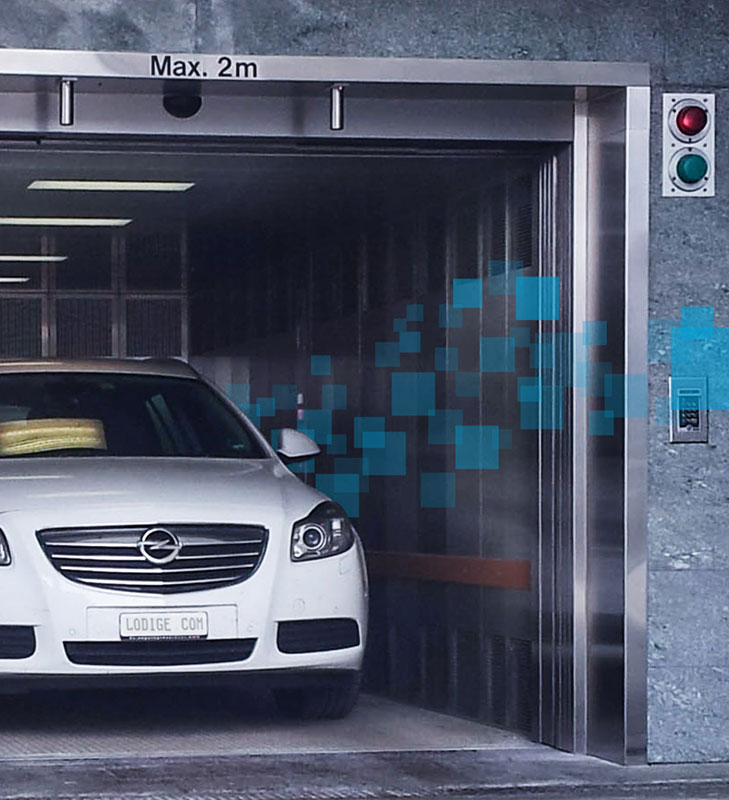
A parking garage elevator is a vehicle-rated lift system designed to transport cars, SUVs, and light commercial vehicles between levels in a structured parking environment. Unlike conventional passenger elevators, these systems are engineered for heavy platform loads, wide clear openings, and the mechanical stress of repeated vehicle loading cycles. Common configurations include hydraulic scissor-type platforms, four-post systems, and fully enclosed shaft-type elevators integrated into high-rise structures.
Demand has grown steadily as urban land values make ramp-based parking increasingly uneconomical. A mid-rise development in a dense urban core that replaces a two-level ramp structure with a vertical lift system can recover thousands of square feet of leasable or saleable floor area. Architects and developers working on mixed-use towers, underground parking expansions, and premium residential projects are specifying car elevators designed for structural load demands at a rate not seen a decade ago.
Key Compliance Requirements Under the 2025 Standards
For vehicle elevator systems specifically, four areas of the 2025 code warrant close attention from procurement teams and facility engineers.
- Emergency power and recall: The system must demonstrate controlled descent or floor-level parking during a power failure, with verified voice and signal alerts confirming safe car park. This places new demands on control panel design and backup power sizing.
- Gate and door integrity: Gates on vehicle platforms must carry higher impact ratings. Anti-lift interlocks—preventing platform movement unless gates are confirmed closed and locked—are now mandatory rather than recommended. Understanding the structural load-bearing considerations for car elevator installation is therefore more important than ever when specifying gate hardware.
- Drive technology and overload protection: Variable-frequency drive systems, already common in modern car elevators, align well with the 2025 emphasis on controlled motion and reduced mechanical stress. Reviewing VVVF technology and its benefits for car elevator performance clarifies why this drive type is becoming a de facto standard for compliant installations. Equally, the overload protection standards in modern freight and car elevators define the sensor and cut-off specifications now required.
- Digital maintenance logging: Component life ratings, service intervals, and inspection results must now be captured in a verifiable format. Buyers should confirm that any elevator system they specify either includes a compatible digital maintenance interface or can integrate with the facility's existing building management platform.
Selecting a Compliant Parking Garage Elevator: What Buyers Should Check
The 2025 standards make the specification process more consequential. A system that passed inspection under 2022 code may require upgrades before it satisfies the new requirements—which means buyers evaluating new installations have an opportunity to get ahead of compliance costs by specifying correctly from the outset.
Four questions should anchor any procurement evaluation:
- What is the rated platform capacity, and does it cover future vehicle sizes? Heavy-duty platforms rated for 5,000 kg or above accommodate SUVs, pickup trucks, and light commercial vehicles—future-proofing the installation against fleet changes.
- Does the system include code-compliant gate interlocks and emergency power provisions? Request written confirmation that the supplied system meets ASME A17.1-2025 gate integrity and backup power requirements, not a previous edition.
- What drive system is fitted, and how does it handle load variation? Variable-frequency drives reduce mechanical wear and enable smoother control under varying load conditions—both operationally and from a code compliance standpoint.
- How is maintenance documented? Reviewing the key safety features of modern freight elevators illustrates the overlap between vehicle lift and freight elevator compliance frameworks—both now demand traceable, time-stamped service records.
VOSAM Car Elevators: Built for Modern Parking Demands
VOSAM's car elevator series is engineered with the load ratings, drive technology, and safety architecture that align with current and emerging regulatory requirements. Platform capacities, anti-fall mechanisms, and VVVF-driven control systems are specified to meet the performance expectations of commercial developers, parking operators, and private property owners working in markets where 2025-standard compliance is already a project prerequisite.
For projects ranging from underground residential parking to multi-level commercial structures, VOSAM offers configurations sized to the space and traffic demands of each application. Consulting directly with the technical team early in the design phase—before structural drawings are finalized—is the most effective way to ensure the selected system integrates cleanly and complies fully with the updated code.